
Methodology
Executive Summary
In October 2019, the first edition of the Global Health Security (GHS) Index was published. The GHS Index drew from extensive evidence and expert consensus to assess the factors influencing countries’ preparedness to prevent, detect, and respond to infectious disease threats. Only a few months later, the emergence of a novel coronavirus put those assumptions to an unprecedented real-world test, as COVID-19 evolved into a global pandemic. The 2021 edition of the GHS Index sought to incorporate lessons from the pandemic and from other emerging health threats, drawing from expert consultations, academic literature, policy analysis, and expanded datasets on health system performance, governance, financing, supply chains, and public trust. These analyses have highlighted not only the importance of core technical capacities, but also the critical roles of political leadership, risk communication, social cohesion, equitable access to countermeasures, and resilience across interconnected systems.
Global health threats continue to evolve—including the growing risks posed by climate change, antimicrobial resistance, rapid urbanization, conflict, and advances in biotechnology. A joint effort of the Nuclear Threat Initiative (NTI), with Economist Enterprise and Brown University, the GHS Index framework has been further refined to reflect a broader and more dynamic understanding of health security. Improvements in data availability and methodological approaches have enabled more nuanced assessments of countries’ capacities, while underscoring persistent gaps in preparedness and response. Building on the 2019 and 2021 Global Health Security Indices, the 2026 Africa Health Security (AHS) Index is a tool that assesses African countries’ health security preparedness and response capacities—a continent-specific index and analysis for African public health and health security leaders. The 2026 AHS Index includes research for the 54 African countries1. Country research was conducted from June 2025 through January 2026. Economist Enterprise conducted the research for this index through a combination of qualitative assessments of publicly available country information and examinations of existing quantitative datasets.
The GHS Index and AHS Index are formed of a multidimensional analytical framework, commonly known as a benchmarking index, designed to be an objective, country-level assessment tool. A multidimensional framework is a useful way of measuring performance that cannot be directly observed, such as a country’s economic competitiveness or, in this case, a country’s health security conditions. Indices, in such cases, are effective in several ways: (a) they can aggregate a wide range of related data and evaluate it consistently; (b) they can track outcomes over time; and (c) they can spur countries to improve performance, especially relative to other countries in the index. In this way, indices can be a useful tool for public policy reforms.
Indices, however, are not without their limitations. The GHS and AHS Index frameworks, as with other models, should be viewed not as a predictive measure, but as an assessment for understanding the existing capacities of countries to prevent, detect, and respond to outbreaks, whether deliberate, accidental, or naturally occurring. The actual impacts of an infectious disease threat (e.g., health, economic, social) are shaped by many factors, including political decision-making, the type of disease, its mode of infection, and even random chance.
Although there are many factors that influence real-world country capacity, the AHS Index can only include factors that can be measured and that produce transparent, available data that allow them to be observed. For this specific index, Economist Enterprise also relied on data sources and information that were publicly available (rather than gathered through expert interviews or internal knowledge), which further limited possible data sources. This decision was made for two reasons: one, to reduce the reporting burden by individual countries, and two, to incentivize countries to publicly share their capacities with the rest of the world.
Using the Africa Health Security Index model
The indicators in the 2026 AHS Index are embedded into this website. Within the website, there are numerous ways of viewing and analyzing the data. For example, users can build custom reports for their own needs, highlighting the countries and specific variables they are most interested in.
The data are also available in a downloadable Excel workbook that offers a wider range of analytical tools, thereby allowing a deeper investigation into measures of health security in the continent. For example, users can filter countries by region or by income level, or can directly compare any two countries. The model also includes (renormalized) data from the 2019 and 2021 GHS Indices, allowing users to view country performance for all Index years (note: Data for 2019 and 2021 have been rescored and renormalized to the 54-country sample to accommodate changes made to the Index since their publication). A user can also examine bivariate correlations between indicators.
The AHS Index model is designed to allow users flexibility in how they analyze the data. Although the AHS Index model relies on a neutral weighting scheme for analysis, the weights assigned to each indicator can be changed by the user to reflect different assumptions about the importance of categories and indicators.
Finally, the model allows the final scores to be benchmarked against external factors that may potentially influence global health security, such as gross domestic product (GDP) per capita, the United Nations Development Programme’s (UNDP) Human Development Index, and many other relevant factors. The background indicators also include two COVID-19-specific metrics collected by the Economist Enterprise team assessing whether the country has made publicly available 1) de-identified COVID-19 health surveillance data and 2) COVID-19 contact tracing data.
Overview of changes to the 2026 AHS Index
In light of discussions and research conducted since the launch of the 2021 GHS Index, the AHS Index framework has been revised to account for new lessons and considerations for what global health security preparedness entails. The Index is meant to measure health security capacities at a national level, and the performance of a particular country depends on whether capacities are leveraged in preparation for and in response to a pandemic.
This Index includes a total of 190 individual metrics (or questions), compared with 171 in 2021 and 140 in 2019. The 2026 AHS Index includes new and revised questions on climate change and health security; medical countermeasure development and delivery; and health systems and equity, among others. Changes to the framework involved a combination of revising existing indicators (changes to indicator question language and/or scoring and measurement) and introducing new indicators.
The amendments to the 2026 AHS Index framework have been made in two tranches.
- International panel of experts (2023): In March 2023, following a panel discussion on the framework with a group of international experts, Economist Enterprise implemented the changes to 38 questions within the framework, including the following:
- 16 new questions were added
- 18 questions’ language was amended
- 4 questions’ scoring guidance was amended
Please note that Economist Enterprise backscored these 38 indicators to allow for comparison between the countries included in the 2026 AHS Index across 2026, 2021, and 2019.
- Reference group meeting (2025): In May 2025, Economist Enterprise, NTI, and Brown University convened a reference group of experts from across Africa to ensure that the framework and the overall research program effectively serve the needs of African public health and health security leaders. Following this, feedback was received on a total of 21 questions, including:
- 12 revisions to questions that had already been revised in 2023, including:
- 9 questions’ language was amended
- 3 questions’ scoring guidance was amended
- 9 revisions to indicators that had not been revised in 2023, including:
- 3 new questions were added
- 5 questions’ language was amended
- 1 question’s scoring guidance was amended
- 12 revisions to questions that had already been revised in 2023, including:
Backscoring is the process of retrospectively applying new or revised indicators and scoring methodologies to historical data so that past index scores remain comparable with the updated framework. The aim is to maintain a consistent time series, allowing trends over time to reflect real changes in performance rather than methodological updates. Economist Enterprise’s approach to backscoring the majority of the indicators for 2019 and 2021 was as follows:
- For revised indicators, the team examined 2019 and 2021 data and scores used in the GHS Index and investigated whether they have changed or remain appropriate given the indicator’s revision.
- For new indicators, the team members identified data sources that they could guarantee were available in the year of focus and determined scores based only on those sources, not on later sources that may be available now.
- Once the raw data scores were collected, Economist Enterprise renormalized them using the 54-country sample assessed in the AHS Index, rather than the full 195-country set used in the global iterations of the index.
Please note that, of these changes, revisions to 12 questions were requested once research had already started. As such, due to resource limitations, these indicators were not backscored following the aforementioned approach. These included the following:
- 7 had the question language amended (1.2.1a, 1.2.1d, 1.6.1a, 3.1.1b, 4.1.1c, 5.1.1a, 6.4.2a)
- 1 had scoring guidance amended (3.1.1a)
- 4 were completely new questions (1.2.1e, 2.3.3a, 6.5.1f, 6.5.2c)
Instead, the following alternative approach to backscoring was applied:2
1. Approach for backscoring the seven revised questions with amended language
The scores from the 2021 and 2019 indices are available based on the prior wording for all seven questions with amended language. Of these seven questions, there was a large change in scores for two questions between 2021 and 2026 where it was unclear whether the change was due to the revised question wording or a real increase in capacity:
- 1.2.1a: Are there national legislation, plans, or equivalent strategy documents for zoonotic disease prioritization, detection and reporting?
- 1.2.1d: Is there a department, agency, or similar unit functioning as a multi-sectoral co-ordinating mechanism dedicated to zoonotic disease that functions across ministries?
The approach was to use the 2026 AHS Index justifications to rescore for 2021 and 2019. The team assumed that countries that did not have these capacities in 2026 also did not have these capacities in 2021 or 2019. For countries that had these capacities in 2026, the team reviewed the 2026 justifications to determine when the capacity became available and adjusted scores for 2021 and 2019 as needed.
The scores for the other five questions either stayed the same across all years or, if changed, appeared driven by increased capacity. For these, the team used the 2021 and 2019 GHS Index scores as the AHS Index scores for 2021 and 2019.
2. Approach for backscoring the one question with amended scoring guidance
Question 3.1.1a was the only question in this set that required revision to the scoring guidance. In 2021 and 2019, the highest score a country could receive on 3.1.1a was a 2. In 2026, the highest score a country could receive on question 3.1.1a was a 3. As such, the team collapsed the scores of 2 and 3 in 2026 to compare across years. The team continued to present separate scores for 2026 in the country scorecards so that the team can distinguish between countries with plans that are funded (score = 3) and countries with plans but no evidence of funding (score = 2).
3. Approach for backscoring the four new questions (not previously included in the 2019 or 2021 frameworks)
Of the four new questions, two were qualitative (1.2.1e and 2.3.3a) and two were quantitative (6.5.1f and 6.5.2c). For the two qualitative questions, the team used 2026 AHS Index justifications to rescore for 2021 and 2019. The team assumed that countries that did not have these capacities in 2026 also did not have them in 2021 or 2019. For countries that had these capacities in 2026, the team reviewed the 2026 justifications to determine when the capacity became available and adjusted scores for 2021 and 2019 as needed. Note that this is the same approach as the one taken for the two questions that had amended language. For the two quantitative questions, the approach was as follows:
- 6.5.1f (age-standardized prevalence of mental health disorders) – used data from previous years from the Institute for Health Metrics and Evaluation (IHME) to rescore
- 6.5.2c (percentage of healthcare facilities with no access to any electricity supply) – where available, used data from previous years in the World Health Organization (WHO) database to rescore
For a full overview of the new and revised questions, please see the section “Sources and definitions of indicators.”
A final change of note is the approach to the default weighting scheme. In the 2019 GHS Index, the default weighting scheme relied on expert weights; for the 2021 GHS Index, the default weighting scheme used neutral weights. The 2026 AHS Index uses the same neutral weighting scheme as the 2021 GHS Index. Previously, the 2019 GHS Index had given less weight to certain categories than to others; Category 4 (Health Systems) and Category 6 (Risk Environment) have proved to be tremendously important in shaping individual country responses to the COVID-19 pandemic and had been given less weight previously. A best practice in index methodology development is that in the absence of certain knowledge of which factors matter most, all factors should be treated similarly. Therefore, for report analysis and final scoring, each category of the 2026 AHS Index has been assigned equal importance (neutral weights).
Scoring criteria and categories
The 2026 AHS Index consists of 190 questions grouped into 38 indicators across 6 overarching categories (see Figure A1). The Index includes research for 54 countries from the African continent.
The overall score (0–100) for each country is a weighted sum of the 6 categories. Each category is scored on a scale of 0 to 100, in which 100 represents the most favorable health security conditions and 0 represents the least favorable conditions. A score of 100 does not indicate that a country has perfect national health security conditions; likewise, a score of 0 does not mean that a country has no capacity. Instead, the scores of 100 and 0 represent the highest or lowest possible score, respectively, as measured by the AHS Index criteria. Each category is normalized on the basis of the sums of its underlying indicators and subindicators, and an identical weight is then applied. The default weights used in the ranking are based on neutral (or identical) weights. The weights in the Excel workbook, however, are dynamic and can be changed by users.
Figure A1. AHS Index framework
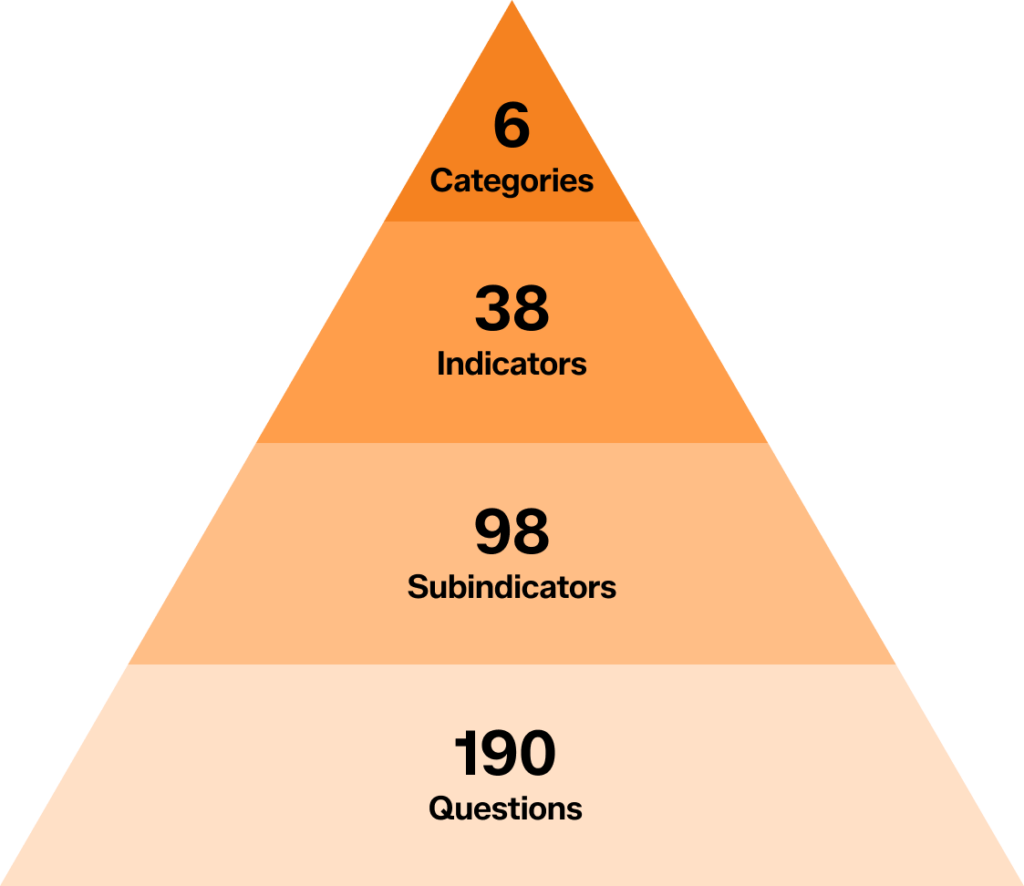
The six categories are as follows:

1. Prevention: Prevention of the emergence or release of pathogens, including those constituting an extraordinary public health risk in keeping with the internationally recognized definition of a Public Health Emergency of International Concern. Indicators in this category assess antimicrobial resistance (AMR), zoonotic disease, biosecurity, biosafety, dual-use research and culture of responsible science, immunization, and climate change adaptation and vector transmission.

2. Detection and reporting: Early detection and reporting for epidemics of potential international concern, which can spread beyond national or regional borders. Indicators in this category assess laboratory systems’ strength and quality, laboratory supply chains, real-time surveillance and reporting, surveillance data accessibility and transparency, case-based investigation, and epidemiology workforce.

3. Rapid response: Rapid response to and mitigation of the spread of an epidemic. Indicators in this category assess emergency preparedness and response planning, exercising response plans, emergency response operation, linking public health and security authorities, risk communication, access to communications infrastructure, and trade and travel restrictions.

4. Health system: Sufficient and robust health system to treat the sick and protect health workers. Indicators in this category assess health capacity in clinics, hospitals, and community care centers; supply chain for health system and healthcare workers; medical countermeasures and personnel deployment; healthcare access; communications with healthcare workers during a public health emergency; infection control practices; and capacity to test and approve new countermeasures.
 5. Commitments to improving national capacity, financing, and adherence to norms: Commitments to improving national capacity, financing plans to address gaps, and adhering to global norms. Indicators in this category assess International Health Regulations (IHR) reporting compliance and disaster risk reduction; cross-border agreements on public health and animal health emergency response; international commitments; completion and publication of assessments and gap analyses from the WHO Joint External Evaluation (JEE) and the World Organisation for Animal Health (WOAH) Performance of Veterinary Services (PVS) Pathway; financing commitments and plans; and commitment to sharing of genetic and biological data and specimens.
 6. Risk environment: Overall risk environment and country vulnerability to biological threats. Indicators in this category assess political and security risks; socioeconomic resilience; infrastructure adequacy; environmental risks; and public health vulnerabilities that may affect the ability of a country to prevent, detect, or respond to an epidemic or pandemic and increase the likelihood that disease outbreaks will spill across national borders.
Each indicator within the six categories contains up to seven underlying subindicators. The categories, indicators, and subindicators are shown in Table A1.
Table A1. AHS Index framework by categories, indicators, and subindicators
Index constraints and other important factors
In researching the 2026 AHS Index, Economist Enterprise relied solely on publicly available sources, such as laws, regulations, policy documents, and government websites. This research approach has the benefit of creating a fully transparent and repeatable methodology that does not create an additional reporting burden for country officials; however, it also presents some challenges. As a result, the 2026 AHS Index may not capture certain preparations that countries have made to improve their health security status in certain domains. For example, some countries may not have strong e-government policies and may not have published existing laws and policies applicable to this research. Other countries may have elected not to publish certain material that they deem sensitive, such as regulations and policies related to biosecurity, which would then lead to an underestimation of scores in those areas.
Additionally, relying solely on publicly available data has limitations on the types of questions that can be credibly researched. For example, the AHS Index cannot capture processes that are often not publicly documented or available, such as the level of activity of cross-ministerial working groups or the average response time between the identification of an emergency and the initiation of a response.
However, there is immense value in restricting the research scope to publicly available information for two principal reasons: (1) Although these limitations could be addressed through an interview process, this approach would create an extra reporting burden for country officials, which can divert attention away from implementation, and (2) there is value in making this information available, both to the international community and to the health workforce within each country. As such, Economist Enterprise, in consultation with NTI, pursued this approach, as was the case for the previous 2021 GHS Index.
Methodology
General
The 2026 AHS Index comprises categories that are related to the health security conditions of each country. To score the indicators for the Index, the research team gathered data from the following sources:
- Primary legal texts and legal reports
- Government publications and reports
- Academic publications and reports
- Websites of government authorities, international organizations, and nongovernmental organizations
- Economist Intelligence proprietary country data and reports (specifically Risk Briefing and the Democracy Index)
- Local and international news media reports
See the “Sources and definitions of indicators” section for more information about central sources.
The 2026 AHS Index assessed the capacity of 54 countries (listed in alphabetical order) in Table A2.
Table A2. African countries assessed in AHS Index
Expert consultations
The framework for the 2021 GHS Index was initially updated from April to June 2020 and later revised in April to June 2021 on the basis of additional lessons from the COVID-19 pandemic. This updated framework is based on the 2019 GHS Index framework, which was developed over an 18-month period from 2017 to 2019. The initial 2019 framework was based on project team analysis, literature review, and standard accepted measurements for global health security as captured in the WHO Joint External Evaluation (JEE) tool and elsewhere.
The 2019 and 2021 GHS Index frameworks and the new 2026 AHS Index framework were further revised, drawing from insights and commentary from an international panel of experts. For the 2019 GHS Index, expert panel meetings were held in April 2017 and April 2019 in London. For the 2021 GHS Index, the expert panel was reconvened for virtual meetings in May and June 2020 and in April 2021. For the 2026 AHS Index, the expert panel was reconvened for virtual meetings in March 2023.
During these meetings, experts offered insights and recommendations on the proposed structure, questions, and data sources for the Index. The panel insights were augmented by additional discussions with experts in the field, such as experts on One Health and epidemiology. For the 2026 AHS Index, a reference group of experts from across Africa was consulted in May 2025 and was invited to provide strategic guidance throughout project development and implementation, ensuring that the project effectively serves the needs of African public health and health security leaders. These discussions informed revisions to the indicators and the individual questions that comprise the AHS Index framework.
Data review and validation process
After completing the research, NTI’s partner Brown University, in partnership with the University of Tunis El Manar and the University of the Witwatersrand, Johannesburg, conducted a thorough review of Economist Enterprise’s preliminary results. The purpose of this data review and validation process was to ensure the accuracy of the 2026 AHS Index data.
Data modeling
Data were collected across 190 questions and metrics. The majority of the qualitative questions are binary (yes or no) questions, although a few are tiered to have two to four possible scoring options to capture more nuanced observations. Each question is constructed so that a higher value is associated with more favorable health security conditions.
For example, for the question on personnel vetting to regulate access to locations with sensitive biological materials (1.3.3a), a country that requires drug testing, background checks, and psychological or mental fitness tests is assigned a value of 3; a country that requires two of the three checks is assigned a value of 2; and a country that requires only one of the three is assigned a value of 1.
Model weights
The weights in the 2026 AHS Index are neutral weights. This set of weights assumes equal importance of all categories and evenly distributes weights on that basis. This approach has the advantage of simplicity and does not involve subjective judgment. A disadvantage of this option is that it assumes that all categories are equally significant.
In the Excel workbook, users have the option of inputting custom weights to test out different assumptions.
Table A5. Default weights by category
Table A6. Weight profile by indicator
Research behind selected indicators
This section focuses on the research behind selected indicators, and it includes an explanation for the scoring framework behind select new and revised questions included in the 2026 AHS Index. Scoring criteria for all of the indicators are included in the section titled “Sources and definitions of indicators.”
Approach
Economist Enterprise employed country experts and regional specialists with a wide variety of necessary linguistic skills to undertake the research from its global network of analysts and researchers. Researchers were asked to gather data from primary legal texts; government and academic publications; and websites of government authorities, international organizations, and non-governmental organizations. Researchers also reviewed local and international news and media reports. The research process proved challenging, both because of the difficulty in sourcing data and official information related to health security and, in some cases, because of a lack of publicly available information.
Sources and definitions of indicators
Table A8. Sources and definitions of background indicators
Country classifications
As part of this work, the team grouped countries by income level, region, and whether they are fragile or conflict-affected. The country classifications are listed below.
Groups by income classification
Low income
|
|
Lower middle income
|
|
Upper middle income
|
|
High income
|
Groups by region
Central Africa
|
|
Eastern Africa
|
|
Northern Africa
|
|
Southern Africa
|
|
Western Africa
|
|
Groups by fragile or conflict-affected situation
Conflict
|
|
Institutional and social fragility
|
|
Citations
- The AHS Index includes the 54 African countries that are State Parties to the International Health Regulations (IHR [2005]).
- All approaches were agreed upon by the AHS Index Reference Group.